2026 Employee Wellbeing & Engagement Trend Report
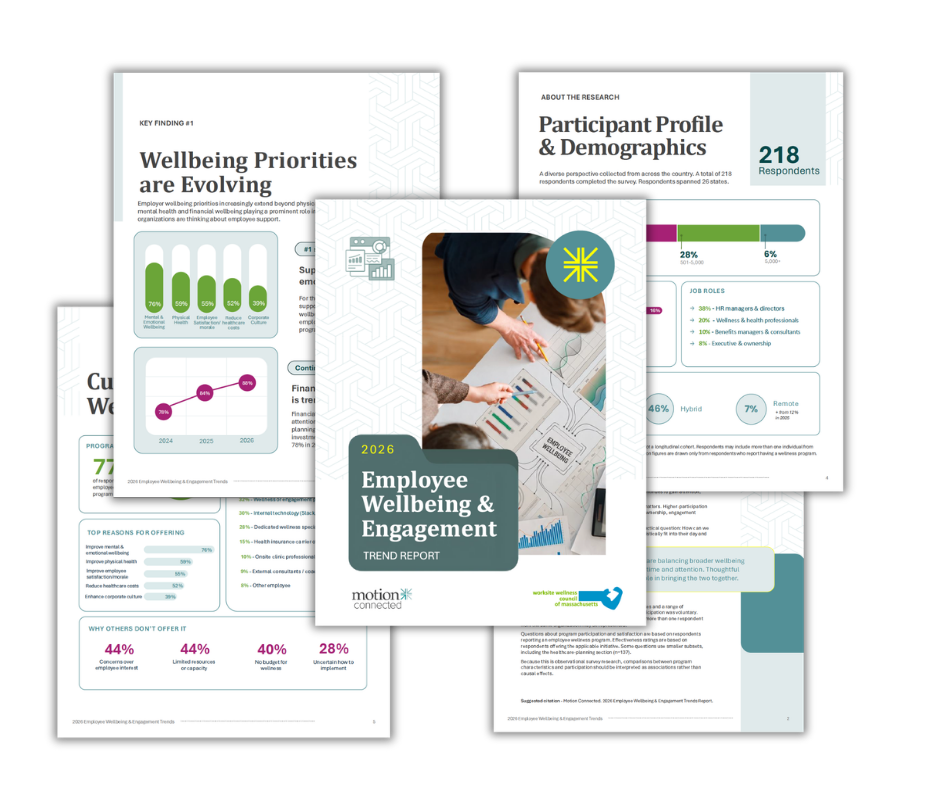
Explore the Trends
Discover the latest employee wellbeing and engagement trends shaping workplace wellness programs. Motion Connected’s 2026 Employee Wellbeing & Engagement Trend Report shares insights from 218 survey responses, exploring employer priorities, participation barriers, incentives, and strategies for building more engaging wellbeing programs. Use these findings to help guide your organization’s 2027 wellbeing strategy.
About the Research
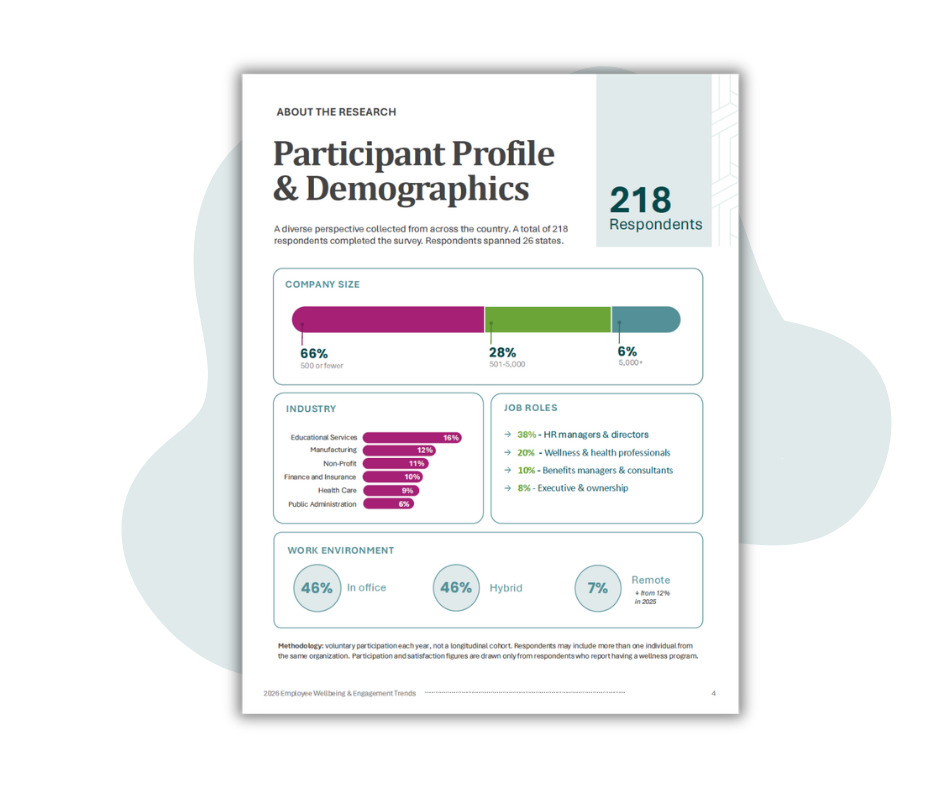
The 2026 Employee Wellbeing & Engagement Trend Report was developed by Motion Connected in collaboration with the Worksite Wellness Council of Massachusetts, humanworks8, and Migliaro Consulting. The survey was conducted August 3–15, 2026, and received 218 responses, providing insight into how employers are approaching workplace wellbeing and employee engagement.
Our Key findings
This year’s findings show how employer priorities are evolving, and highlight several characteristics associated with stronger employee participation.
-
Wellbeing priorities are evolving.
Mental and emotional wellbeing remains the #1 reason employers offer a program, while financial wellbeing continues to see increased investment.
-
Time is the biggest barrier to engagement.
54% cite lack of employee time and 49% cite competing priorities as the biggest barriers to getting employees to engage. -
Higher-value incentives are associated with higher participation.
Average participation ranges from 43% among programs offering $0–$100 in annual incentive value to 66% among those offering more than $1,000. -
Higher-participation programs share several characteristics.
Programs reaching 50%+ participation report higher average incentive values and are more likely to have dedicated ownership, use an engagement platform and track participation.
2026 Employee Wellbeing FAQs
What are the biggest employee wellbeing trends in 2026?
According to Motion Connected’s 2026 Employee Wellbeing & Engagement Trend Report, mental and emotional wellbeing remains a leading employer priority, while financial wellbeing continues to receive increased investment. Employers are also focusing on improving participation, reducing engagement barriers, and evaluating the effectiveness of incentives.
What prevents employees from participating in workplace wellness programs?
Time and competing priorities are two of the biggest barriers. In Motion Connected’s 2026 survey, 54% of respondents cited lack of employee time, while 49% identified competing priorities as barriers to engagement.
Do wellness incentives increase employee participation?
Motion Connected’s 2026 research found an association between higher incentive values and stronger participation. Average participation ranged from 43% among programs offering $0–$100 in annual incentives to 66% among programs offering more than $1,000. These findings show a correlation, not proof that larger incentives directly cause higher participation.